

The sounds of Marble Advance
A sound journal of playful mallets, quiet Caribbean jazz, and enough space for the marbles to be heard.
We want Marble Advance’s music to suggest that the marbles are quietly plotting something: playful, curious and a little mischievous. The design question is how to give a long puzzle session that character while leaving the small sounds of shots, clears and advancing files easy to hear.
Our next musical direction explores a mellow tenor steelpan in a small Caribbean jazz ensemble, with sparse melodic replies, rounded bass and quiet hand percussion. Space between phrases matters as much as the notes: the instruments can answer one another without crowding the game. The composition studies explore that balance; the existing loop and menu mix show why continuity and restrained levels matter during play.
Keep the ensemble small
The intimacy of the marimba-based direction is our starting reference. Steelpan offers another voice for that same scale of play: bright and rounded, with room for short, slightly comical melodic turns.
We are interested in a single mellow tenor steelpan carrying the melody. Upright bass can give it a soft bounce. A few hand-played percussion accents can suggest movement. Guitar, piano or a second mallet voice can answer occasionally, without filling every gap.
The restraint is deliberate. We want to borrow rhythmic ideas and instrumental colours while keeping the music close and conversational. Large steel ensembles, heavy dance rhythms, dense percussion and dramatic builds would change the size of the scene.
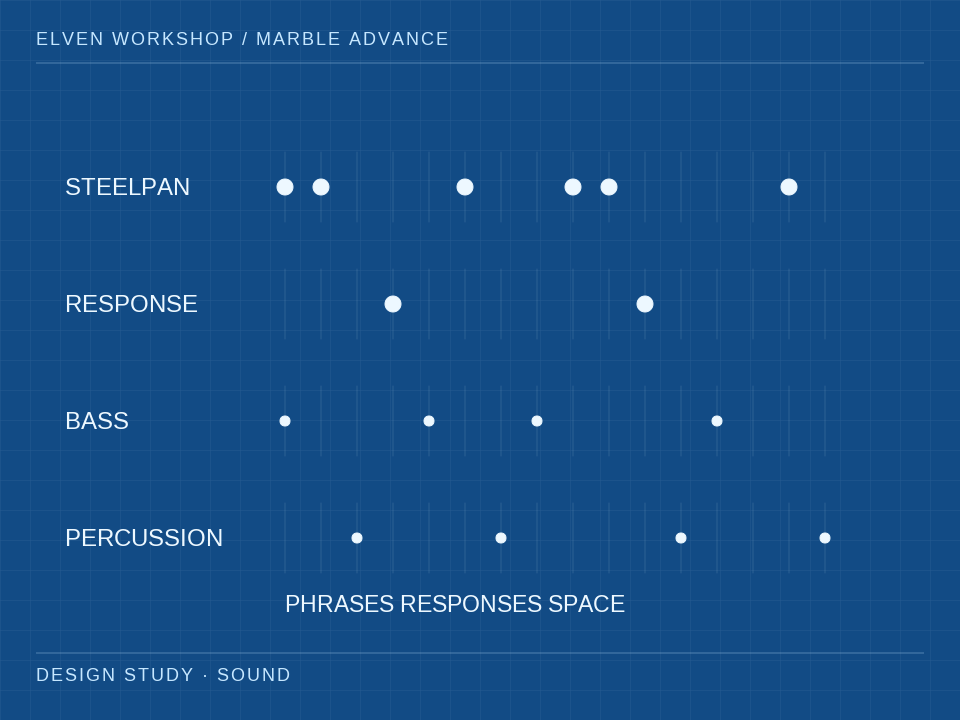
- A short melodic thoughtThe steelpan can be curious and playful without becoming a continuous solo.
- An occasional answerA second voice responds in the gaps, keeping the group conversational.
- A soft pulseBass and small percussion accents support movement while leaving room for game cues.
Four ways the marbles might plot
These are composition briefs for the next musical direction. Their tempos, instrument roles and phrasing give each study a distinct character before we treat a recording as a finished gameplay loop.
Steelpan Sneak
Composition study / 76 BPM
A mellow tenor steelpan takes the curious, tiptoeing role of the original Tiptoe Trouble concept. Upright bass answers with a lightly bouncing line, while quiet bongos and the occasional clave keep the pulse small.
The melody needs pauses and little chromatic turns: a phrase that peeks around a corner, stops, then tries another route. This is the first study we would use to explore steelpan as a signature voice.
Coconut Footsteps
Composition study / 82 BPM
Steelpan sits with nylon-string guitar, upright bass and delicate congas. The guitar contributes occasional muted offbeat chords, giving the group a gently lilting calypso-jazz feel.
The important word is occasional. Each player leaves room for someone else’s small surprise. The groove should support a long puzzle session without turning the board into a dance floor.
The Lazy Lagoon
Composition study / 72 BPM
Steelpan and marimba trade tiny melodic phrases, rarely speaking together. Sparse upright bass and a barely audible shaker let the two mallet colours make the conversation.
This is the dreamier, slightly mysterious study: small creatures exploring a tropical garden. Alongside Steelpan Sneak, it is one of the first directions we want to explore, because the shared melody could give Marble Advance a particularly recognisable voice.
Island Hide-and-Seek
Composition study / 86 BPM
A single steelpan exchanges short motifs with quiet jazz piano. Soft bass and dry woodblock accents give the piece a little cartoon-detective character.
The mischief comes from rhythmic hesitations, offbeat answers and the odd unexpected note. We want it clever and gently humorous, with steady energy that can keep looping while you concentrate.
Turn a piece into somewhere you can stay
Composition also means thinking about the return to the beginning. A satisfying ending for a standalone piece can become an interruption when the same music accompanies a long run.
The current Hidden Clues intro edit is a concrete example. Its loop is built on a 92 BPM grid, cut around a 48-bar return to the opening phrase—about 125.2 seconds. A short blend carries the tail across the seam. The edit avoids relying on the original ending’s different harmony simply because it falls on the beat grid.
Opening the menu keeps that same loop in place while lowering and softening it with a low-pass filter. Coming back restores the clearer mix. That gives the menu the feeling of a door closing slightly on the room, without starting the tune again.
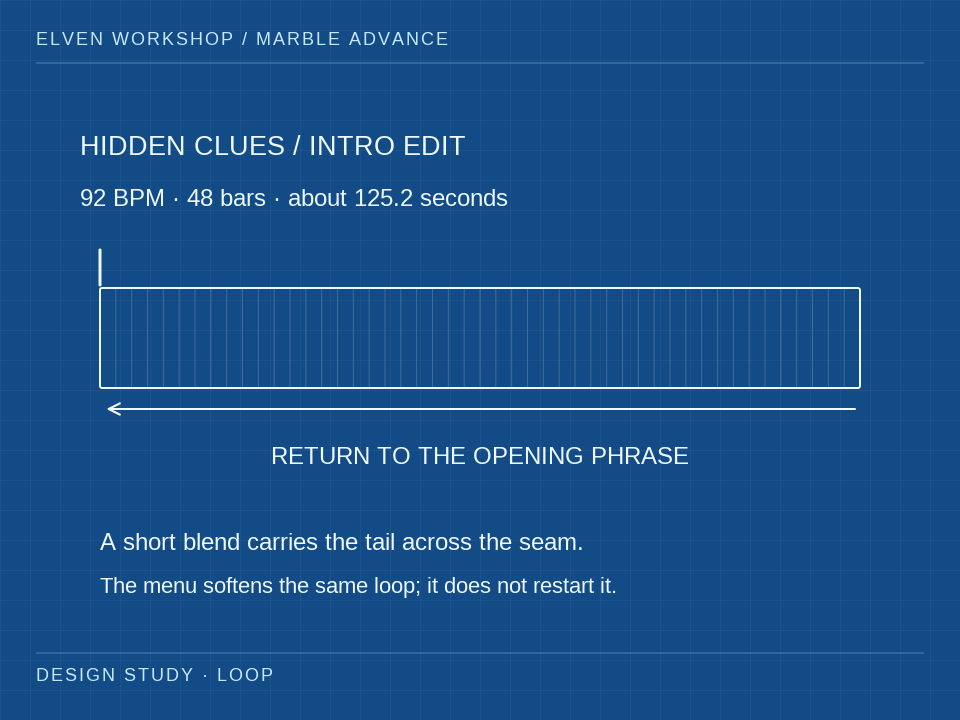
- Choose a musical returnThe existing intro edit follows the opening phrase’s 48-bar reprise.
- Join the seamA short blend continues the tail into the next opening attack.
- Keep your placeThe menu softens the same loop; it does not restart it.
Leave the foreground to the game
The present effects palette uses edited Cyberwave Orchestra samples: short swishes for launch and return, a small crumbling clear, a quiet shuffle for the advance, and distinct sounds for special pieces. Those cues have to remain understandable over the music.
The music files are prepared at a restrained level so those small actions can speak. Ambient level tracks vary between levels without immediately repeating the previous selection. Sound and Music also have separate controls, so players can keep the feedback they find useful.
That balance is the common thread between the current mix and the new composition studies. A little pulse underneath, a little mischief in the gaps, and enough quiet space to hear what the marbles have just done.