

Designing the next fraction of a second
The calculations behind Lock Pick’s gradual squeeze on preparation time—and why a reaction allowance is different from a hit window.
We wanted Lock Pick’s timing challenge to tighten gradually, giving players room to learn the ring before asking them to react sooner. That meant considering target placement, needle speed and acceleration together: a smaller gap and a faster approach both change the time available to prepare.
We reduce the target-placement allowance from 580 to 320 milliseconds in small steps, keep a floor on that value and allow extra travel for ring changes and recovery. The actual hit still depends on the visible needle and target overlapping. These choices let the pressure grow while preserving room to read what changed; the placement allowance is a tuning value, not a fixed reaction deadline.
Give the next target an allowance
The placement calculation starts with a reaction allowance of 580 milliseconds. Each new stage reduces that value by 30 milliseconds, until it reaches 320 milliseconds at stage ten. It stays at that floor in later stages.
This is a tuning value used to choose where a new target can appear. It is separate from the shorter interval during which the needle and target actually overlap.
The placement allowance
580 ms − 30 ms × (stage − 1), with a minimum of 320 ms.
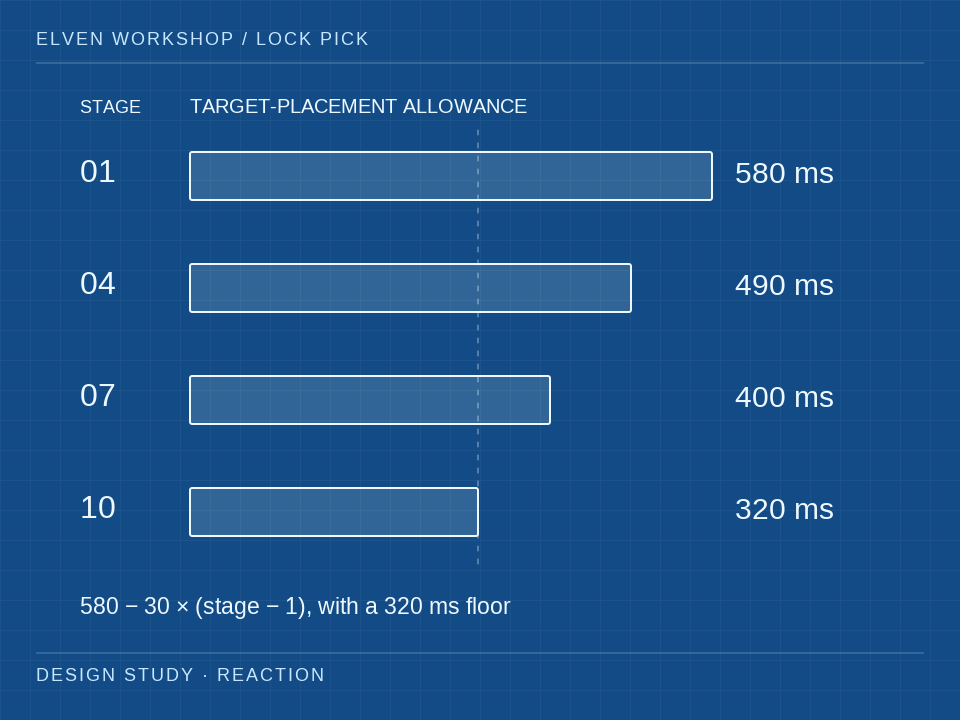
- Start with room to readThe opening allowance is 580 milliseconds.
- Reduce it graduallyEach stage subtracts 30 milliseconds from that tuning value.
- Keep a floorStage ten reaches 320 milliseconds. Later stages keep that allowance.
Turn time into distance
The needle is moving around a circle, so the target needs an angular position. We turn the allowance into a distance using the needle’s starting speed and acceleration: distance equals starting speed multiplied by time, plus half the acceleration multiplied by time squared.
The result is checked against the stage’s minimum and maximum target separation. A new target is then sampled within the permitted range. Ring changes and recovery rounds can add further travel.
Those distance bounds matter. The allowance does not mean every stage-one target arrives exactly 580 milliseconds after it appears. A wider sampled gap can give you substantially more preparation. The visible shapes begin overlapping before their centres meet, too.
Let several small changes build the pressure
The base speed ceiling rises with stage. Successful musical phrases can raise it further. The needle starts each round below its ceiling and accelerates towards it, with both acceleration and maximum speed capped.
Meanwhile, the stage’s angular separation range becomes tighter. You are learning to read a meeting that can be closer and can arrive faster. The difficulty grows through the relationship between those choices.
For a clean comparison, hold the musical tier at zero and choose the minimum sampled gap. Using the native game’s capped-motion calculation, stage one takes about 1.47 seconds to reach the target centre; stage ten takes about 0.55 seconds. These are controlled examples that isolate stage progression, not a measurement of every live target.
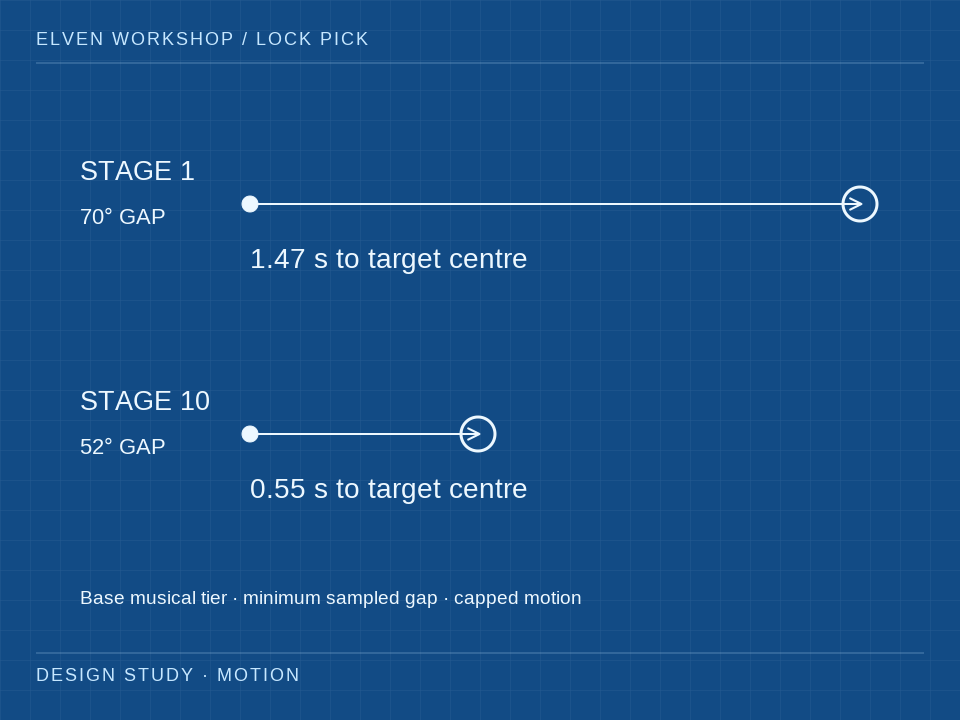
- A controlled comparisonBoth examples hold musical tier at zero and use the minimum sampled gap.
- Capped motionThe calculation includes acceleration and the speed ceiling.
- A separate hit windowYou can tap while the marker shapes overlap; centre arrival is only a reference point.
Judge the overlap, not a perfect instant
A target has width, and so does the needle. The game checks their angular overlap rather than demanding an infinitely precise meeting of two centre points. Their sizes and the ring’s radius determine the angular window.
Speed turns that angular window into time. A faster needle spends less time inside the same window. Acceleration can change its speed during the approach, which is why the motion calculation uses elapsed time rather than a fixed number of pixels per frame.
The 320-millisecond placement floor therefore does not freeze the whole difficulty curve. It stops one tuning value from shrinking indefinitely while other parts of the game continue to evolve.
Give attention time to move
Switching rings asks you to find a new track as well as a new target. The game adds travel according to the distance between rings. A recovery round also allows extra travel, giving the next attempt some breathing room.
That is the design aim behind the numbers: a gradual invitation to react sooner, with room to understand what changed. The calculations serve the moment you feel when the needle is almost there.