
The sound of a small arcade
Bright marks, rising notes and the little sounds that make a run feel alive.
We wanted Lock Pick’s sound to communicate the result of a tap quickly and give a run its arcade rhythm. The choices concerned the character, length and relative weight of each cue: a hit, a miss, an extra life and an unlock should be easy to tell apart.
We use a small vocabulary of synthesized waveforms, with rounded rising hit tones, a rougher falling miss and a more generous extra-life chime. The repeating phrase becomes more insistent as a run develops, while the larger mechanical and celebratory sounds belong to the unlock. Keeping everyday cues brief leaves space for the next timing decision, with visual feedback carrying the same information when sound is off.
Start with a small vocabulary
The gameplay sounds are synthesized from simple waveforms. Each has a useful personality: a triangle wave gives the repeating phrase its shape, sine tones give a hit a rounded response, and a sawtooth gives the miss a rougher edge.
Keeping that vocabulary small makes the events easier to distinguish. A successful tap gets a short rising pair. A miss falls in pitch. The extra-life cue climbs through three notes, making it a bigger reward without needing a long fanfare.
There is a design advantage to those short shapes. You can hear the result and return to the next meeting. A timing game has very little spare room for a sound that keeps asking to be heard after its job is done.
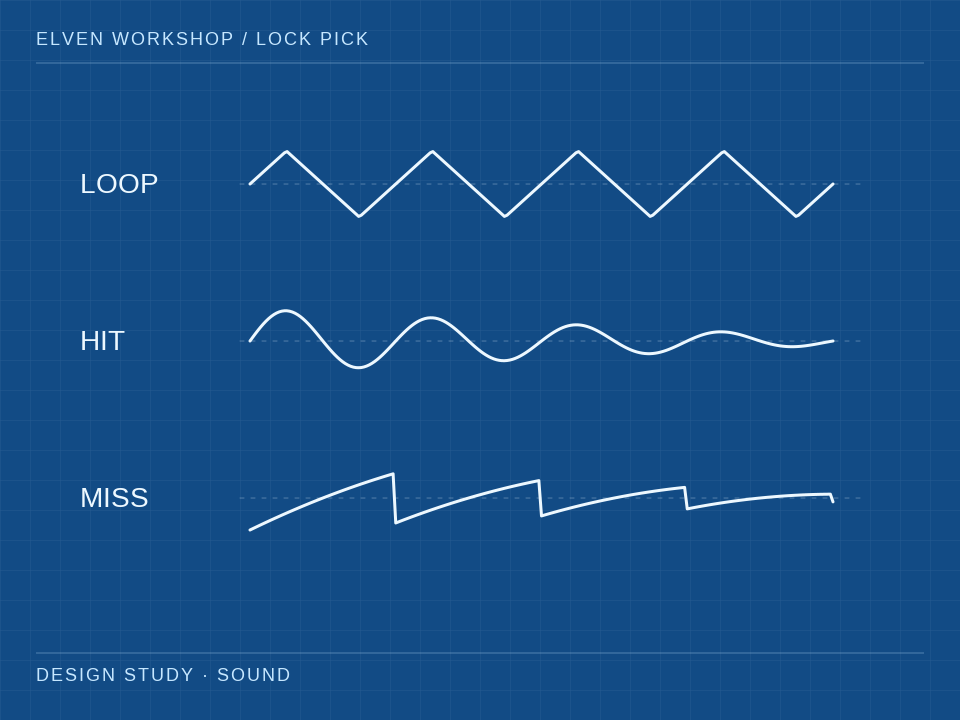
- The loopA repeated triangle-wave phrase gives the run a pulse.
- The hitA short rising pair of rounded tones answers a successful tap.
- The missA rougher, falling cue makes the setback sound different.
Let a run find its rhythm
The repeating phrase is part of the progression. As the run advances through its musical tiers, the notes rise and the interval between them shortens. The phrase becomes more insistent alongside the play.
That gives repetition somewhere to go. The same small musical idea can feel measured at one moment and more urgent at another. It belongs to the run you are building.
The sound is also a second route into the feedback. When your eye is still following the needle, a hit cue can confirm the tap. An extra-life chime can announce a reward before you take a moment to check the keyholes.
The screen still carries the important information when sound is off. Early and late feedback, the life display and the remaining-match counter have to explain themselves visually too.
Borrow the energy of the arcade
The visual treatment follows the same instinct: bright marks, a strong dark field, a score worth chasing and an immediately recognisable response to a mistake. Those choices give a tiny action some stage presence.
The ring needs contrast because its important elements move. The counter needs to be legible because a glance is often all it gets. The keyholes need to read as a group because you are checking your remaining chances between taps.
The retro character grows out of those jobs. It is in the economy of the symbols and the certainty of the responses, as well as the luminous colour and synthesized notes.
Save the bigger sound for the bigger moment
The unlock is the payoff. It gets a crisp mechanical cue and a short burst to accompany the celebration. The controls have their own quieter, tactile sounds. The current mix combines synthesized gameplay tones with selected sound-effect samples for those other jobs.
That hierarchy matters. A menu press, a clean match, an extra life and a cleared lock should have different weights. If every sound is a celebration, the stage ending has less to give you.
We want the final unlock to feel earned. The little sounds along the way help you hear the shape of the run that brought you there.